|
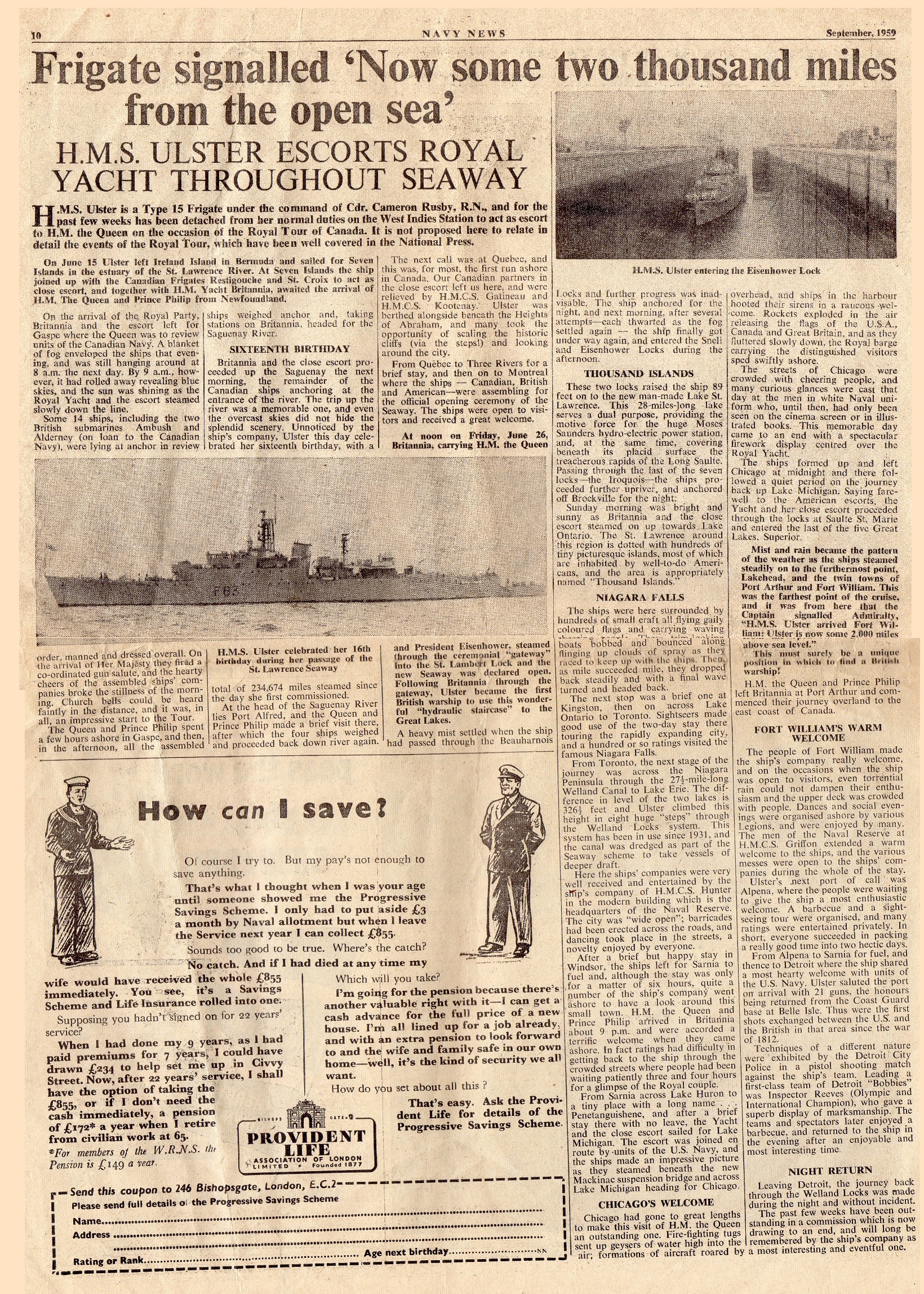
H.M.S. ULSTER The first
anti-Submarine Frigate now visiting Nassau is the first ship in
the Royal Navy to bear the name of ULSTER. She was originally
built as a destroyer and was completed in June 1943. After
service in the English Channel, H.M.S. ULSTER went out to the
Mediterranean at the end of 1943 and remained
their until May 1944 when she
returned to Home Waters to take part in the Normandy invasion.
H.M.S. ULSTER went out to the Pacific at the end of 1944 and
took part in operations again at Okinawa and Sakashima Islands,
on 31st March, 1945, but was severely damaged during an air
attack on the Fleet. ULSTER then returned to the United Kingdom
to repair and be refitted. From 1946 to 1953 ULSTER was in
commission as a training ship and aircraft target ship in Home
waters. |
She was reduced to Reserve at the beginning of 1953 at
Devonport where she remained until mid-1955, when she was
taken to H.M. Dockyard, Chatham, to be converted to a Fast
Anti-Submarine Frigate. This conversion
necessited the stripping down
of all the old armament, super structure and living
accomodation and new
aluminium upper works being built. The ship is therefore
virtually new except for hull and main machinery. On 7th
March, 1957, the ship was commissioned at Chatham t for
service on the West Indies Station, returning to the United
Kingdom in May, 1958.
H.M.S ULSTER recommissioned in Devonport in August, 1958,
for further service on the West Indies Station
|
Commodore Wilfred John Parker, O.B.E., D.S.C., Royal Navy,
Senior Naval Officer, West Indies Station, is currently visiting
Nassau aboard H.M.S. Ulster.
Born in October, 1915 in Mussoorie, India, Commodore Parker
joined the Royal Naval College, Dartmouth, in 1929.
A Communications specialist,
Commodore Parker held appointments in the Second World War as
Signal Officer and Flag Lieutenant to Admiral Sir Stuart
Bonham-Carter and Admiral Sir Cecil Harcourt in Home Fleet and
Mediterranean
Cruiser Squadrons. During this time he saw service on Arctic
convoys, the North African Landings and the operations in Sicily
and Salerno. He was awarded the Distinguished Service Cross in
December, 1943. |
Since the war Commodore Parker has served as Fleet Signal
Officer on the Staff of the Commander-in-Chief, Mediterranean
from 1949 to 1951 and commanded the destroyer COMUS during the
latter part of the Korean War. He was also Chief Staff Officer
to the Flag Officer, Second in Command, Far East Station, for a
short time. For these services he was awarded the O.B.E.
Promoted to Commander in December, 1948, and to Captain in June,
1954, Commodore Parker has lately been a student at the Imperial
Defence College and Duputy
Director of Naval Recruiting at the Admiralty. He has been twice
mentioned in Dispatches.
Married with two daughters born in 1945 and 1949, he is living
in Bermuda whilst holding |
this appointment. Mrs. Parker is the daughter of Colonel A. N.
Jones of Halifax, Nova Scotia.
Commodore Parker has had no previous service in the West Indies
but visited Trinidad, Barbados, Antigua, St. Lucia and Bermuda
as a Cadet in the Training Cruiser PROBISHER in 1933.
He assumed the appointment of Senior Naval Officer, West Indies,
in the Rank of Commodore Second Class on 5th. June, 1958. |
 Site Directory |