![]() |
Norrie's Net |
![]() |
|
Don't forget to
promote the RNA in general and your Branch in particular |
||
|
|
||
|
Guest Book Closed due invasion of disgusting links. I am working on a resolution. Please leave your comments by clicking on contact webmaster |
||
|
Once Navy - Always Navy |
||
Click for larger imageH.M.S. Ulster
Memories of Ulster
Ulster crew of other than the 1958-60 commission can record their memories here. If you have an interesting Ulster anecdote, experience or very short yarn let me know by clicking HERE
[Click Image to Enlarge]Fire at Sea
By Trevor BaldwinCopyright © 1995 by Trevor Baldwin
Radio Operator (R.O.)
HMS Ulster 1957 Crew
One of the most traumatic events of my life occurred while serving in the Royal Navy as a communicator onboard H.M.S. Ulster, soon to be outward bound for the West Indies. While doing exercises prior to taking up our Guard-ship duties in the Caribbean we passed through the Bay of Biscay. There was a very heavy fog and the Ulster made her way, slowly, in compliance with shipping regulations during this unpleasant weather. The visibility was down to about 40 yards and closing. I was on solo watch in the Radio Room and the time was about 11:00 pm. The ships of the world are required by Geneva Convention to observe radio silence on certain frequencies at certain times, worldwide. At about 11:08am, as I sat typing the broadcast weather report, a familiar sound came over from the FM12 standing in the corner: Note: Non Windows Explorer surfers will have to click HERE to hear Morse code /... --- .../... --- .../... --- .../- .-. --.-/ -.-. --.-/
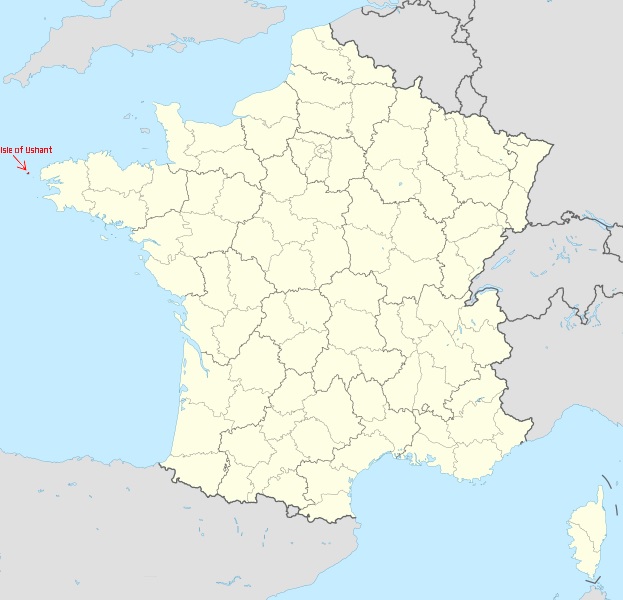
I read it automatically; I was trained to do that. The signal sounded again: /... --- .../... --- .../... --- .../ t was so familiar to me, but for some reason, I could not make head or tail of it. t. The signal was loud, which usually indicated that the transmission was being generated locally. I moved my earphones to the forward ear position and listened again, more closely. The wireless operator was sending something else: ......stony point .........lision with unknown....v..sel on fire, position................. The message began to repeat. "Hells Bells," I said aloud. "It's a bloody' SOS." I hadn't recognized it at first, but now I was sure. I dropped my earphones on the desk and let the broadcast run on, went over to the receiver that was permanently set on the distress frequency, took my pad and began to take the message. SOS SOS SOS CQ CQ CQ DE etc, etc. M.V. Stony Point. I am in collision with unknown vessel. On fire. My position is 40 miles SW of the Isle of Ushant. Request immediate assistance. Master... I ran to the bridge phone. "Wireless Room to Bridge. Emergency! Emergency!" "Bridge" I relayed the message I had just received, and told them to inform the Petty Officer Telegraphist and have him come to the Wireless Room. "Roger! That accounts for the two blips that just came together on the screen. Thank You, Sparks." Three minutes later, the PO Tel came into the office. He had his cap on, but no shoes, and was still stuffing his shirt tails into the top of his pants. "What have we got?" I showed him the signal, which at this time was being repeated for the fifth time. The tannoy came alive again as the Captain called for the P.O. Tel. "Tell the Stony Point we're on our way, we are about twenty miles to the west of him, we'll make our best time". Even as the Captain spoke, I felt the ship 'sit down' and take off. Emergency Stations sounded and the whole ship was alive in less that two minutes. The rest of the Communications staff arrived at the office and took their stations. The excitement was becoming intense. I felt a pain in my kidneys but passed it off as cramp. After flying through the water at our top speed, (somewhere in the region of 38 knots, or about 43 miles an hour), through thick fog with visibility down to 20 yards, we arrived at the scene around forty minutes from the Captain' s order. We entered a clearing in the fog caused by the heat and flames. We seemed to be in a huge dome, surrounded by the thick wall of fog. One ship was ablaze; burning off the fog in a large circle around the collision scene. The loannis was smoking and had been on fire, but there were no flames at this time. One ship was ablaze; burning off the fog in a large circle around the collision scene. Since the accident had happened during the night, many of the sailors had rushed from their sleeping quarters onto an upper deck under which a ferocious fire was blazing. Many of them left their quarters without shoes on. As a result, the heat from the deck burned their feet completely to the bone. Some of the men had fallen onto the hot decking, and were severely burned about the upper torso, arms, legs and face. Many of them had jumped into a sea that was covered with a blazing oil slick from ruptured tanks.
It must have seemed to them that there was no way they could save themselves. Some of the men were non-swimmers, but there were no boats available to them, because they were burning in the flames. Still, they preferred to take their chances in the water, than remain on the hot deck.
There were a lot of men in the water and no life rafts as I recall. I could clearly see the shoulders and upper torso of at least two drowned men, bobbing gently in flat calm water. Both ships were dead in the water. The Ulster came as close as she could . The heat from the fire on the Stony Point decided the prudent distance. Pumps were lowered into the cutter and the whaler with fire-fighting crews, and both were sent over to the burning ships. The Captain's cutter was lowered into the water to pick up survivors. As we continued with our task of rescue, other ships arrived at the scene to help. H.M.S. Ulster was in charge of the rescue, and the other ships stood by. A doctor from a cruise liner gave assistance in our sick bay. When the whaler returned, she had a couple of badly burned bodies onboard. One of them had been alive when they picked him out of the oil in the water, badly burned, and coughing uncontrollably. He died a few moments after his rescue. When we had done all that was possible for us to do, we left the area to the ocean going tugs to get their salvage operations underway for the ships involved in the collision. There were a lot of heroes that day, and I was pleased to have been of assistance in receiving the signal. I would have cause later to think of the possible consequences, if I had fallen asleep, or been drunk while on watch; But that is another story. On the way to the nearest port, the injured were given the best attentions of our Medical Officer, and his staff. Eventually, we ran out of morphine, and some of the less injured were given rum to ease their pain! As the ship docked at Brest, in the south of France, there were all kinds of people on the quayside trying to get a closer look. Ambulances lined up along the jetty, to take away the dead and injured. Port authorities, and police were everywhere. It had been a terrible night, a night of death at sea. Fear and terror had been abroad on the high seas. In the morning, after my all night watch, I strolled onto the transom. A large awning was strewn over the deck, I thought it was for cleaning. I walked across it and it felt bulky underneath and kind of soft under my flip-flops. A voice yelled at me to get off the tarp. "There are dead bodies under it!" I leaped onto the metal decking with a feeling that I had desecrated the men. I felt sick, there was an awful burned flesh smell emanating from the transom. I walked back toward the safety of my quarters. As I approached the hatch, I passed by some of the survivors, and felt a great sadness for them. I continued forward, and saw the Master of the Stony Point, with his head in his hands, crying for the loss of his crew and his ship. I went along to the heads, locked myself in a cubicle and wept. It had been a long night, and my mind had been impressed as to how sudden death can come, and how horrible a pain some people must bear to go through it.
The following is an extract from the Daily Express, dated Wednesday 19th June 1957.
OIL TANKERS ABLAZE IN CRASH - 8 DIE.
MEN FROM BRITISH WARSHIP GO ABOARD TO FIGHT FLAMES.
Brest, Wednesday,. Two oil tankers collided in heavy fog 30 miles west of Brest today, and burst into flames. Eight seamen are known to be dead. The two ships are the 10506-ton tanker
Stony Point and a Greek tanker named loannis, 9,345 tons, flying the Liberian Flag, were in collision in fog.The British Frigate, ULSTER, 2,100 tons, arrived at Brest this evening with the seven dead and 27 survivors, mostly from the Stony Point. They included her Master,
Mario Cappelleto. All the men from the Stony Point were Italians.Ten injured were landed and taken to the Naval Hospital there. The total number of survivors is believed to be about 40,
First messages picked up by French Radio stations said the Stony Point had sunk, but later it was learned that after being abandoned by the crew, she remained afloat, and men from a Dutch Tug were fighting the flames.
The German vessel.
ERIK RECKMANN. 1,305 tons, was the first to approach the two vessels. She took on board 26 men from the IOANNIS and 25 from the Stony Point. An urgent call to ships at sea for a doctor was sent.Meanwhile the ULSTER arrived and took onboard some injured and survivors. Another German ship, the merchantman
KEITUM, 1710 tons, picked up 13 survivors, who were later transferred to the ERIK RECKMANN.SHIPS SAIL - AMBULANCE MEN ONBOARD.
Rescue operations were carried out in a dense white fog, which was blackened by columns of black smoke spreading from the burning ship. The United States liner, AMERICA, 33,961 tons, and the other vessels off the Brittany coast also steamed to the rescue.
The powerful French Tug
RHINOCEROS, and the French escort, CHEVREUIL, 1,647 tons, with a doctor and ambulance men onboard were sent out.Other vessels also sailed from Boulogne and St. Nazaire while the French Liner
CHARLES TELLIER, 12,007, changed course and made for the spot. Aircraft took off from airports near Brest and Lorient, but they had to turn back because of the fog.Shortly after 4pm, the
CHEVREUIL sent out a radio message saying that the Dutch tug; THAMES had arrived 2 hours earlier, and that a prize crew had boarded the Stony Point. Later it radioed that the fire onboard the tanker had been localized.The doctor who attended the men
was Surgeon - Lieutenant P.G. Harries, R.N of Swansea. He visited two ships from the ULSTER to tend the injured.The
IOANNIS made her way into Brest under her own steam. After news of the collision, crowds gathered at the port. Rooms were prepared for the survivors in two hospitals there. The ULSTER left Brest for Plymouth this evening with some survivors.The following was copied from an internet site called Cat Collective in May 2002. and concerns superstitions surrounding Cats. Since it mentions the two ships involved, I thought it might be interesting to place in my little book
"Another curious case was that of the ship's tabby cat aboard a tanker, the Stony Point. The cat had joined the ship, via a crew member, ten months earlier and had settled down to a life at sea, until the tanker called at her last port before embarking on what was to prove the ship's final voyage
As the tanker was about to sail the cat came up on deck and leaped a 20 foot wide gap on to the quay and evaded attempts to recapture it by workers on the quay. The tanker sailed and later collided with another ship,
loannis, with a heavy loss of crews' lives." New addition: - Press Cutting received January 6th, 2006 [Click on article to enlarge]
I was again reminded of this disaster some 10 years later; When, as a Chief Radio Supervisor in the R.N.R., I made a courtesy visit to the Royal Navy frigate
H.M.S Galatea, berthed at the Alexandra Docks in my home town of Hull, England. Tied up on the other side of the quay was a tanker. Her new name, painted in white on her black bow, did not cover the welded- on letters beneath it. It was the loannis, repaired and back in service.Trevor Baldwin was born in Hull, England just before the Second World War. He was evacuated, with his mother to Leverton, in Lincolnshire during some of the heaviest bombing in his home town.
About the author.
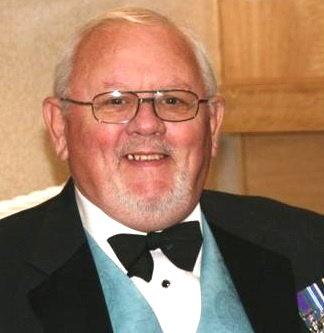
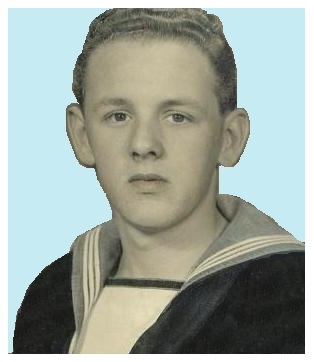
Trevor BaldwinRadio Operator [R.O.] HMS Ulster 1957 Crew
He graduated Beverley Road High school at the age of 15. After a brief period of working on Barges, Tugs and Trawlers, joined the Royal Navy at the age of 16.
Trevor served in the Royal Navy and Reserve for 25 years until he retired to emigrate to the United States in 1979.
He retired from his working life as a Quality Control Officer with a large luxury speedboat company, and has settled down to follow his many interests; one of which is writing.
Trevor currently has over
250 poems and numerous stories in copyright. He is a prolific writer and keeps a daily journal, recording at least 350 words per day.He and his wife, Joan, now live in Williston, Florida and have
6 children, 15 Grandsons and 11 Granddaughters 12 Great Grandsons and 11 Great Granddaughters, most of whom live in Florida.Other works by the author.
Every One a Hero ~ Testimony ~ Harry and the Pension Book ~ Mother's Day ~ Day Trip ~ Shoes
1995 by Trevor Baldwin
Copyright ©.
New Addition
Submitted by M(E)1 Tony Woodman 1957-58 Commission.I was on watch in the Boiler Room at the time Trevor must have picked up the distress signal and can confirm his comments about the thick fog although looking up was blue sky. We were moving at a very slow speed. It's a long time ago now but I don't think we had any more than two sprayers on. Steam was on the sirens and they could be heard sounding at frequent intervals, then, quite unexpectedly, the telegraphs from the Engine Room sounded for more steam and very soon we were doing a fair rate of knots, in thick fog! We were unaware of what was going on at the time but it was obviously a flap of some kind. Bridge may have told Engine Room but nobody told us!
I went onto the upper deck when I came off watch and made out two ships that had collided. They were both in a bad way, the oil tanker with a huge column of thick black smoke hundreds of feet high and evil looking red flames.
I was interested in Trevor's "Fire at Sea" item as I went across, with others, in one of the ship's boats to the Ioannis where some of our lads boarded to do some fire-fighting. I can confirm Trevor's comment about the heat coming from the ships The heat could be felt long before we were alongside. We took "Ulster's" "portable(!)" diesel fire pump across with us. My task was to keep the suction side of the hose under the surface of the sea to avoid loosing suction, which, because of the heavy swell causing the ship to wallow, was very difficult and I became so exhausted that I didn't think that I would manage. However, suction was maintained.
Another thought!
I can remember, just myself, being in the boat alongside Ioannis trying to prevent that hose from surfacing when a passenger ship hove-to quite close by with countless people lining the upper-deck. There must have been hundreds of cameras and photographs taken and it would have been quite a picture for the photo album. Needless to say, I never did see any.
Addendum
Going back to the Ushant collision and the passenger ship, which I'm sure hundreds of photographs were taken, the same would apply to Brest. Like Trevor, I couldn't help noticing hundreds, countless people, crowding every vantage point when we entered harbour where we disembarked the dead seamen. I remember them being taken down the gangway on stretchers, one at a time, draped under the White Ensign and being piped off with the General Salute to the waiting ambulances.
Two interesting video clips:
http://www.britishpathe.com/
video/ship-collision-in- brittany
http://www.britishpathe.com/video/american-tanker-stony- points-in-tow-behind-dutch Questions:
Were you a passenger on that liner?
Were you one of the onlookers in Brest?
Do you know of anyone with pictures of this event?
Some pictures for website would be appreciated.
This page last updated June 14th, 2014
| Guest Book Closed due invasion of disgusting links. Please leave your comments by clicking on contact on contact webmaster. You can still read comments and leave details for me to enter. Thank you. |
| This web site is maintained by Shipmate Norrie Millen,
Teignmouth, Devon, United Kingdom. Send mail to Norrie HERE with questions or comments about this web site. All pages in this directory Copyright © 1999-2022 Norrie Millen. |